

Who May Be a Candidate for Inspire When CPAP Is Not Working?
Struggling with your CPAP mask? Inspire therapy may be an option for some sleep apnea patients—but not everyone qualifies. See who's a candidate and why.
Who May Be a Candidate for Inspire When CPAP Is Not Working?
Snoring is common, and occasional snoring does not necessarily mean something is wrong. However, loud or persistent snoring accompanied by interrupted breathing, daytime fatigue, or poor sleep quality may be a sign of an underlying sleep-related breathing disorder.
Obstructive sleep apnea (OSA) occurs when the upper airway repeatedly narrows or becomes blocked during sleep, causing breathing to decrease or temporarily stop. These interruptions may lower oxygen levels and trigger brief awakenings that help reopen the airway.
Although you may not remember waking up, repeated breathing interruptions can disrupt sleep and contribute to daytime sleepiness, fatigue, and difficulty concentrating.
At Trinity ENT, we help patients in Gilbert, AZ, understand snoring and sleep apnea, explore treatment options such as continuous positive airway pressure (CPAP), and determine when Inspire therapy may be clinically appropriate.
Understanding Inspire Therapy: What Is It?
Inspire® therapy is an FDA-approved implantable upper airway stimulation treatment for certain patients with moderate to severe obstructive sleep apnea who cannot tolerate or do not receive adequate benefit from positive airway pressure therapy.
Unlike CPAP, Inspire does not require a mask or hose during sleep. Instead, it uses a surgically implanted system to stimulate muscles involved in keeping the upper airway open.
How Does Inspire Therapy Work?
The Inspire system includes an implanted device that monitors breathing patterns and delivers mild electrical stimulation to the hypoglossal nerve during sleep.
This stimulation activates muscles that help move the tongue forward, reducing upper-airway obstruction and helping improve airflow.
Patients use a handheld remote to turn the therapy on before going to sleep and off when they wake up.
Although Inspire may be an option for some patients who struggle with CPAP, it requires surgery and ongoing follow-up. It is not appropriate for everyone with obstructive sleep apnea.
A sleep apnea and Inspire therapy evaluation can help determine whether the treatment may be suitable based on your diagnosis, airway anatomy, treatment history, and overall health.
Common Challenges With CPAP
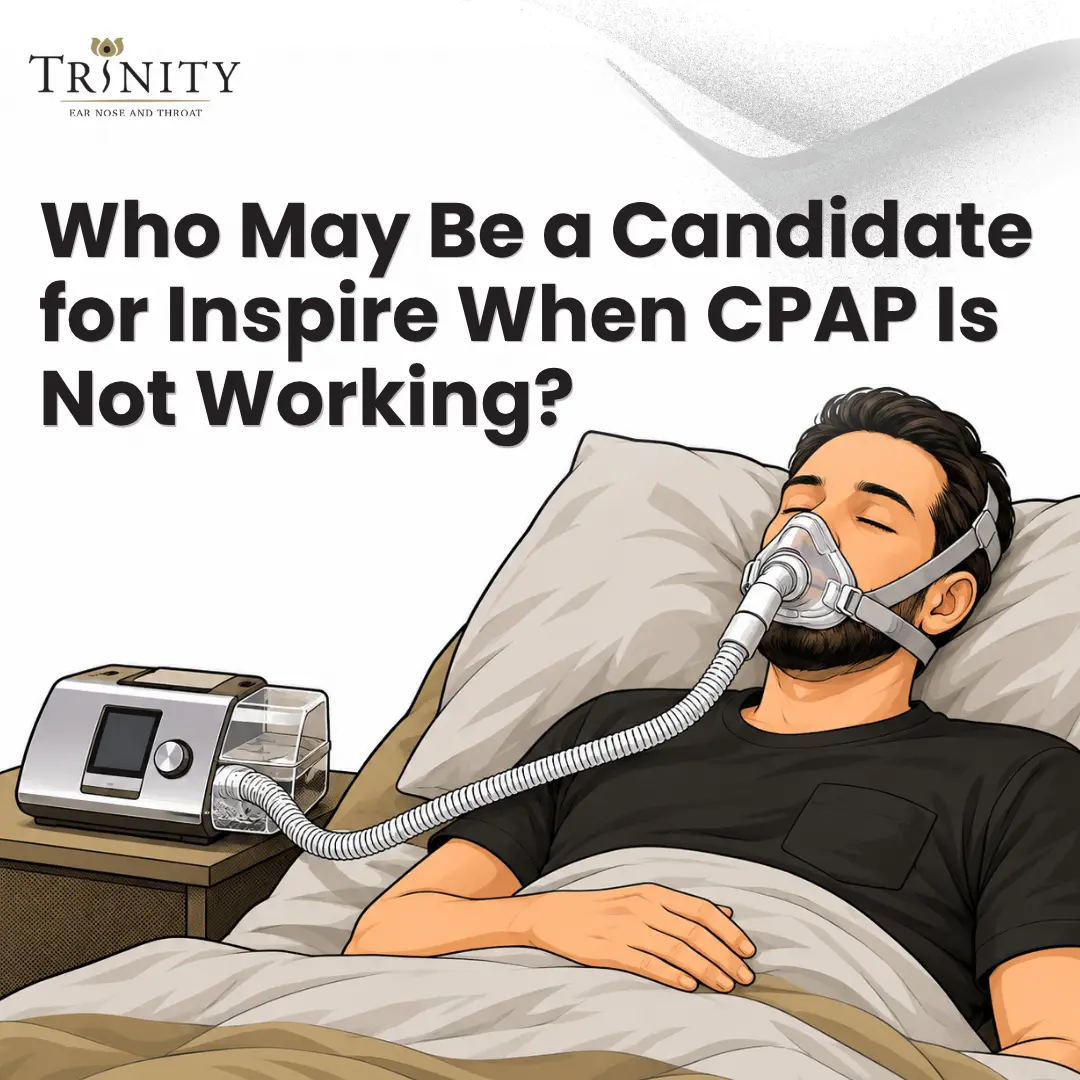
A continuous positive airway pressure (CPAP) machine is a commonly prescribed treatment for obstructive sleep apnea.
CPAP delivers pressurized air through a mask worn over the nose, mouth, or both. This airflow helps keep the upper airway open during sleep.
Although CPAP can be effective, some patients experience difficulties using the equipment consistently.
Common challenges include:
- Nasal or mouth dryness
- Difficulty tolerating the mask
- Feelings of claustrophobia
- Skin irritation from the mask
- Difficulty maintaining a comfortable mask seal
- Trouble sleeping while wearing the equipment
- Unintentionally removing the mask during sleep
Some of these concerns may improve with adjustments to the mask, humidification, or machine settings.
If CPAP remains difficult to use despite appropriate adjustments, your healthcare provider may discuss other treatment options.
However, difficulty using CPAP does not automatically mean that Inspire therapy is necessary or that a patient qualifies for it.
Who May Be a Candidate for Inspire Therapy?
Inspire therapy may be considered for certain patients with moderate to severe obstructive sleep apnea who cannot tolerate or do not receive adequate benefit from positive airway pressure therapy.
Eligibility depends on several factors, including age, sleep apnea severity, airway anatomy, CPAP treatment history, and overall health.
Age of the Patient
According to current FDA-approved indications for Inspire therapy, certain adults aged 18 and older may be eligible.
However, additional eligibility requirements apply to patients aged 18 to 21.
Inspire also has a separate indication for certain adolescents with Down syndrome and severe obstructive sleep apnea.
A healthcare provider can determine which age-related criteria apply to an individual patient.
Severity of Obstructive Sleep Apnea
One important factor in determining candidacy is the severity of obstructive sleep apnea.
Sleep apnea severity is commonly measured using the apnea-hypopnea index (AHI).
The AHI measures the average number of apneas, or breathing pauses, and hypopneas, or partial reductions in breathing, per hour of sleep.
Current FDA labeling includes an AHI range of 15 to 100 events per hour for eligible adults with moderate to severe obstructive sleep apnea.
However, meeting this AHI range alone does not establish eligibility for Inspire therapy.
Type of Airway Collapse
Inspire therapy is designed to help address upper-airway obstruction associated with obstructive sleep apnea.
It is not intended to treat central sleep apnea, which involves interruptions in breathing signals from the brain rather than a physical obstruction of the airway.
The pattern of upper-airway collapse also matters.
As part of an Inspire evaluation, an ENT specialist may perform drug-induced sleep endoscopy (DISE). This procedure allows the provider to examine how the upper airway narrows or collapses while the patient is sedated.
Certain patterns of collapse, particularly complete concentric collapse at the level of the soft palate, may make a patient ineligible for Inspire therapy.
CPAP Intolerance or Treatment Failure
Another important consideration is whether the patient has been unable to tolerate or receive adequate benefit from positive airway pressure therapy.
These situations are generally described as CPAP intolerance or CPAP failure.
CPAP intolerance
CPAP intolerance may occur when a patient cannot use positive airway pressure therapy consistently despite attempts to improve comfort and adherence.
Difficulty with a mask or machine does not automatically establish CPAP intolerance under Inspire's eligibility criteria.
A healthcare provider must review and document the patient's treatment history.
CPAP failure
CPAP failure refers to obstructive sleep apnea that remains inadequately controlled despite positive airway pressure treatment.
FDA-approved Inspire labeling includes specific definitions of positive airway pressure failure and intolerance.
An evaluation can help determine whether a patient's treatment history meets those requirements.
Body Mass Index (BMI)
Body mass index is another consideration during an Inspire evaluation.
Inspire therapy has been studied in patients with a BMI up to 40. Safety and effectiveness in patients with a BMI above 40 have not been established through substantial clinical studies.
However, FDA indications and insurance coverage requirements are not always identical.
Some insurance providers may apply additional BMI restrictions or other eligibility criteria.
Your healthcare provider will consider BMI alongside sleep apnea severity, airway anatomy, treatment history, and other individual health factors.
Who May Not Be a Candidate for Inspire Therapy?
Not everyone diagnosed with obstructive sleep apnea is a candidate for Inspire therapy.
According to Inspire's professional indications and contraindications, factors that may prevent treatment include:
- Sleep apnea that does not meet the applicable eligibility criteria
- Central and mixed apneas that account for more than 25% of the total AHI
- Complete concentric collapse at the level of the soft palate
- Certain conditions that interfere with neurological control of the upper airway
- Inability to operate the sleep remote without necessary assistance
- Pregnancy or plans to become pregnant
- Certain implanted medical devices that could interact with the Inspire system
- MRI requirements that are incompatible with the specific implanted Inspire device
MRI compatibility depends on the Inspire device model and the applicable scanning conditions.
Eligibility is not determined by a checklist alone. A healthcare provider must consider the patient's sleep study results, airway anatomy, medical history, and other clinical findings.
What Are the Risks and Limitations of Inspire Therapy?
Inspire therapy requires a surgical procedure to implant the device.
As with other surgical procedures and implanted medical devices, potential risks and complications may include:
- Infection or bleeding
- Pain or discomfort near the implant site
- Tongue soreness or weakness
- Discomfort from stimulation
- Difficulty swallowing or speaking
- Device-related complications that may require additional treatment
Not every patient experiences these complications, and the risks can vary.
Inspire therapy also requires follow-up appointments and adjustments to the stimulation settings. Some patients may continue to experience sleep apnea symptoms or need additional management.
Your healthcare provider can explain the potential benefits, risks, limitations, and alternatives before you make a treatment decision.
For additional details, review the manufacturer's Important Safety Information.
What Happens During an Inspire Therapy Evaluation?
An Inspire evaluation typically begins with a review of your sleep apnea diagnosis, symptoms, and previous treatments.
Your healthcare provider may discuss:
- Your most recent sleep study results
- Your experience with CPAP or other positive airway pressure therapy
- Adjustments you have tried to improve CPAP comfort
- Your current sleep symptoms
- Your medical history and overall health
- Your airway anatomy
- Other treatment options that may be appropriate
Depending on your situation, additional sleep testing or drug-induced sleep endoscopy may be recommended.
The goal is to determine whether Inspire therapy is clinically appropriate rather than assuming that difficulty with CPAP means an implant is the next step.
Conclusion: Determining Whether Inspire Therapy May Be Right for You
CPAP is an effective treatment for many people with obstructive sleep apnea, but some patients have difficulty using it consistently or continue experiencing breathing interruptions despite treatment.
For selected patients, Inspire therapy may offer another treatment option. However, eligibility depends on more than CPAP intolerance alone.
An individualized evaluation can help determine whether adjustments to existing treatment, Inspire therapy, or another approach may be appropriate.
If you have been diagnosed with obstructive sleep apnea and continue to struggle with CPAP, schedule a consultation with Trinity ENT to discuss your symptoms, treatment history, and potential options.
We provide ear, nose, and throat care services for patients in Gilbert, Mesa, Tempe, Chandler, and surrounding Arizona communities.
More Insights to Explore



The information provided in this article is for informational and educational purposes only and does not constitute medical advice. It is not intended to diagnose, treat, cure, or prevent any disease or medical condition. Always seek the guidance of your physician or other qualified healthcare provider with any questions you may have regarding a medical condition or treatment.
Results may vary: Treatment outcomes and health experiences may differ based on individual medical history, condition severity, and response to care.
Emergency Notice: If you are experiencing a medical emergency, call 911 or seek immediate medical attention.
